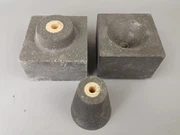
What Is the Difference Between a Tundish Nozzle and a Metering Nozzle?
Apr 29, 2026
- "Tundish nozzle" is a broad term. Any tube, sleeve, or orifice installed at the bottom of a tundish to allow molten steel to flow out can be referred to as a tundish nozzle. It functions like a "discharge pipe."
- A metering nozzle specifically refers to a nozzle with a fixed inner diameter. The size of the orifice determines the flow rate of the molten steel. There is no mechanical valve; the flow rate is entirely controlled by the precise orifice diameter. This is why it is called a "metering nozzle."
Key Differences
|
Comparison Dimension |
Tundish Nozzle |
Metering Nozzle |
|
Core Function |
Stable flow guiding, introducing molten steel from tundish to mold and preventing secondary oxidation |
Precise metering and quantitative control of melt flow rate and velocity to ensure uniform flow |
|
Application Scenarios |
Flow guiding between tundish and mold in steel continuous casting, suitable for conventional continuous casting, clean steel casting, etc. |
Precise flow control in steel continuous casting, non-ferrous metal casting, glass manufacturing and other scenarios requiring quantitative delivery |
|
Structural Design |
Mostly tubular structure, internal channel design focuses on fluency, and the structure is relatively simple |
Precise structure, equipped with flow control mechanisms (slide plate, stopper rod), adjustable channel, focusing on tightness |
|
Performance Requirements |
High temperature resistance, erosion resistance, scouring resistance, reducing inclusions and ensuring stable flow guiding |
In addition to high temperature resistance and erosion resistance, it requires extremely high dimensional accuracy, wear resistance and flow control precision |
|
Core Pain Point Solution |
Solve problems such as unsmooth molten steel flow guiding, secondary oxidation and inclusion pollution |
Solve problems such as flow deviation, inaccurate metering, raw material waste and unqualified product size |
|
Material Selection |
Mostly made of aluminum-carbon and zirconium refractory materials, focusing on erosion resistance and thermal stability |
Adopt high-purity aluminum-carbon and zirconium materials, and some key parts use zirconia materials to improve wear resistance and precision |
Key Considerations for Selection
1. If your requirement is to "stably feed molten steel from the tundish into the mold during continuous casting to ensure billet quality and prevent oxidation and inclusions," then prioritize the Tundish Nozzle-focusing on the product's resistance to erosion and scouring, as well as the stability of the flow, to avoid production interruptions caused by nozzle rupture or blockage.
2. If your requirement is "precise control of melt flow-whether for flow distribution in continuous casting or metered delivery in other industries-with minimal flow deviation and accurate measurement," then prioritize a Metering Nozzle-focusing on the product's flow control accuracy, dimensional precision, and sealing performance to ensure every portion of the melt is delivered precisely, thereby reducing raw material waste and product scrap rates.
Common Misconceptions
- Misconception 1: "Tundish nozzles and metering nozzles are interchangeable" - These components serve different core functions. Using one in place of the other can result in poor flow, inaccurate metering, and even production failures. For example, substituting a tundish nozzle for a metering nozzle can cause excessive flow deviations and lead to non-conforming product dimensions; conversely, using a metering nozzle as a tundish nozzle increases production costs and fails to meet the requirements for stable flow.
- Misconception 2: "Focusing only on price, not quality" - Inferior nozzles have poor heat resistance and corrosion resistance, making them prone to cracking and clogging. This not only leads to frequent downtime but also affects product quality, ultimately increasing production costs. While high-quality nozzles require a slightly higher initial investment, they reduce replacement frequency and minimize waste, offering better value for money in the long run.
If you are unsure which spout is best suited for your specific application, or if you need custom product specifications, please feel free to contact us at any time. We will provide you with professional selection advice and integrated solutions to help make your production more efficient and stable.