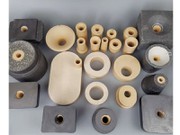
Why Does Tundish Metering Nozzle Clog?
Apr 10, 2026
In continuous casting production, clogging of the tundish sizing nozzle is a long-standing and troublesome problem. Once the nozzle is blocked, molten steel cannot flow down, and continuous casting has to be interrupted. This not only affects output but may also lead to the scrapping of an entire heat of steel. The sizing nozzle controls the stable flow of molten steel into the mold. It has a precise small bore inside, and the bore diameter directly determines the casting speed. Once this small hole is blocked by foreign matter, molten steel can no longer pass through.
High-Melting-Point Deoxidation Products
During steelmaking, elements such as aluminum and silicon are added for deoxidation. They react with oxygen to form high-melting-point substances like alumina (Al₂O₃) and calcium silicate. These inclusions behave like fine sand in molten steel. At the nozzle, due to changes in flow velocity and temperature drop, they gradually adhere to the inner wall, accumulate increasingly, and eventually cause blockage.
Typical characteristics: The clogging material is white or greyish-white with a hard texture.
Secondary Oxidation
From the ladle to the tundish and then to the mold, molten steel is constantly in contact with air, slag, and refractory materials. If protective casting is inadequate, alloying elements in the molten steel will be re‑oxidized, forming new inclusions. These "fresh" oxides are highly active and tend to adhere easily to the nozzle wall.
Easily overlooked points: Poor sealing of the long nozzle and untimely addition of tundish covering agent can both lead to secondary oxidation.
Low Molten Steel Temperature
Each steel grade has an appropriate casting temperature. If the temperature is too low, the viscosity of molten steel increases and its fluidity deteriorates, making inclusions more likely to deposit. More seriously, the molten steel may partially solidify at the nozzle, directly causing the nozzle to "freeze up". This is similar to water freezing in pipes in winter.
Judgment method: If the clogging material has a metallic luster and dendritic crystals, it is mostly caused by solidification due to low temperature.
Precipitation of High-Melting-Point Phases
To improve the castability of molten steel, calcium treatment is applied to many steel grades to convert solid alumina into liquid calcium aluminate. However, insufficient or excessive calcium addition will instead produce high-melting-point calcium aluminates (such as CA₂, CA₆). These substances have melting points above 1600°C, higher than molten steel temperature, so they naturally form solid particles and clog the nozzle.
Industry saying: "Clogging happens with too little calcium, and also with too much calcium" - this is exactly what it means.
Refractory Material Spalling
The Tundish Metering nozzle itself is made of refractory material. If the material quality is poor and erosion resistance is weak, the inner wall will spall and flake after long-term erosion by molten steel. These refractory fragments directly block the bore, causing clogging. Although not common, this type of problem is usually severe once it occurs.
How to Identify the Cause?
Observe the appearance of the clogging material:
- White powdery → alumina inclusions
- Grayish-black flaky → secondary oxidation products
- Metallic luster with dendritic shape → molten steel solidification
- Angular lumps → refractory spalling
Solutions
- Reduce inclusions at the source - optimize deoxidation and calcium treatment processes.
- Prevent oxidation during casting - strengthen protective casting measures.
- Maintain proper parameters - keep molten steel temperature sufficiently high.
- Select high-quality refractories - avoid cheap, low-quality nozzles.
Although Tundish Metering nozzle clogging appears to be a nozzle issue, its root causes actually lie in molten steel cleanliness and process control. When every step from steelmaking to continuous casting is properly executed, the nozzle clogging rate will naturally decrease. If clogging occurs frequently on your production line, you may conduct troubleshooting based on the five aspects mentioned above - the root cause can most likely be identified.
(Clogging causes may vary with different steel grades and operating conditions. Analysis based on actual production situations is recommended.)